Guide · Sourcing, wholesale and production ·
How Is Degreaser Made?
Degreaser production is not ordinary mixing work, because it involves a strong alkaline raw material. This article outlines the process from raw material intake to case packing; it gives no recipe or ratios. For the general production flow, see how detergent is made.
How is degreaser made?
Degreaser is usually made by mixing alkaline ingredients and grease-lifting auxiliaries in water under controlled conditions, adjusting the viscosity where needed, checking pH and appearance, and filling it into alkali-resistant packaging. The result is a product that softens grease hardened by heat on ovens, hobs and grills. Because it is strongly alkaline, occupational safety is an integral part of the production steps.
What is degreaser made of?
- Water: the product's carrier.
- Alkaline ingredients: the main active that softens burnt-on, stuck grease.
- Surfactants: help the loosened grease come away when wiped and rinsed.
- Thickeners: may be used in thick formulas; they help the product stay on vertical surfaces.
- Fragrance: chosen per product; the SDS gives the scent of the START degreaser as lemon.
- Ratios are the manufacturer's recipe and are not given here; hazard information is in the safety data sheets.
General steps in degreaser production
- Raw material intake: incoming raw materials are usually recorded, and packaging and labels are checked.
- Weighing: raw materials are weighed for the batch size.
- Mixing: water usually goes into the tank and ingredients are added in order, under control. Alkaline raw material can release heat as it dissolves, so it is not added all at once.
- Viscosity adjustment: in thick products, the viscosity is adjusted once the mix is homogeneous.
- Scent: in scented products, it is usually added after the other ingredients have been mixed.
- Checks: pH, viscosity and appearance are usually checked before filling.
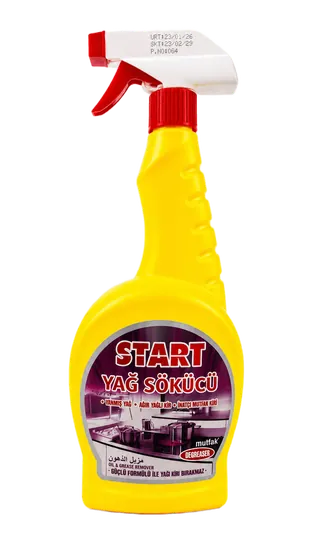
- Filling: the product is usually filled with weight or volume control; START degreaser comes in 750 g, 5 kg, 20 kg and 30 kg packs.
- Capping, labelling, case packing: the cap is tightened, the label applied and small packs go into cases.
Quality control points specific to degreaser
- pH: a value usually monitored in an alkaline product, and it also affects the hazard information. The SDS gives the pH of START degreaser as 12.
- Viscosity: in a thick product, the balance between clinging to vertical surfaces and leaving the pack is usually watched. According to the SDS, START degreaser thickens as temperature falls, so measuring temperature is taken into account.
- Appearance and scent: the SDS describes the START degreaser as clear and transparent with a lemon scent; a cloudy or sedimented batch is usually re-examined.
- Density: in the range of 1.00–1.10 g/cm³ for the START degreaser.
- Fill weight and cap: it is usually checked that the pack has the declared weight and that the cap does not leak.
- Batch record: the production date and batch number are usually recorded together with the measurement results.
- For the criteria to check when choosing a manufacturer: what to look for when choosing a cleaning products manufacturer.
Occupational safety and equipment in production
- Protective equipment: because the product causes severe skin burns and eye damage, gloves, safety goggles and suitable workwear are required.
- Ventilation: weighing, mixing and filling areas are ventilated.
- Separate storage: according to the SDS, the product must not contact acids and acidic substances, strong oxidising agents or alcohol. Acidic raw materials and products are usually kept in a separate area.
- Equipment: aluminium and galvanised metal are corroded by strong alkalis; tanks, pipes and filling parts should be made of alkali-resistant material.
- Line cleaning: at product changeover the line is usually washed with plenty of water; no residue should remain, especially after an acidic product.
- Spills: spilled product is collected without delay, wearing protective equipment, and the area is rinsed.
Filling, packaging and cases
- 750 g: 12 per case; for homes and small kitchens.
- 5 kg: 4 per case; for restaurant, hotel and canteen kitchens.
- 20 kg and 30 kg: single cans; for busy professional kitchens.
- The product is stored in its original packaging, tightly closed and upright, in a dry, cool place out of direct sunlight.
- Product codes and case details are on the START degreaser page.
Label and safety data sheet (SDS)
Each product's hazard symbols are on the label and the details are in the SDS. According to the SDS, the START degreaser carries the signal word “Danger” and the GHS05 pictogram. It causes severe skin burns and eye damage (H314, H318) and may cause an allergic skin reaction (H317). Its transport class is 8.
What the sheet contains is explained in what is a safety data sheet. Use, surface and mixing warnings are in how to use degreaser; it is not used on aluminium, galvanised, painted or non-stick surfaces.
Certificates
- TSE certificate: Our START degreaser is TSE-certified to TS 13396 (degreaser – Type 2: burnt-on grease (oven) cleaner).
- Domestic Goods certificate: We hold a Domestic Goods (Yerli Malı) certificate for degreaser (local content 76.01%).
- For the certificate number and validity date, see the documents and certificates page.
How does degreaser production differ from surface cleaner production?
The two products are made for different jobs. Surface cleaner is for the daily cleaning of surfaces such as floors and tiles; degreaser is for burnt-on, stuck grease. That is why safe work with alkaline raw material, viscosity control and alkali-resistant equipment stand out in degreaser production. For comparison, see how surface cleaner is made.
Can degreaser be made at home?
Not recommended. Strong alkaline raw material causes severe burns to skin and eyes, and it can also release heat as it dissolves. Protective equipment, pH measurement and alkali-resistant packaging do not come together at home. For greasy surfaces, choose a labelled ready-made product and follow its label.
Our degreaser production and supply
We make START degreaser at our plant in Istanbul İkitelli OSB. Capacity and plant details are on the production page.
Tetikoğlu Kimya is a degreaser manufacturer.
To buy degreaser in bulk, see wholesale cleaning products; to sell it in your region, see dealership and distribution; state the product and pack size when you request a quote.