Guide · Bathroom, toilet and limescale ·
What Is a Limescale Remover?
Hard water leaves a white layer on bathroom glass and on the heating element of a dishwasher. A limescale remover is an acidic product used to dissolve this build-up. This guide explains what it is, which type suits which job and what to watch for with an acidic product.
What is a limescale remover?
A limescale remover is an acidic cleaning product used to dissolve the scale that calcium and magnesium in water leave on surfaces or in machines. Its main job is to dissolve mineral build-up.
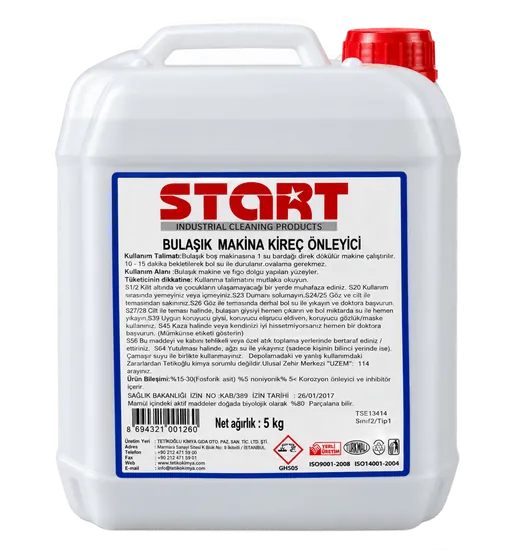
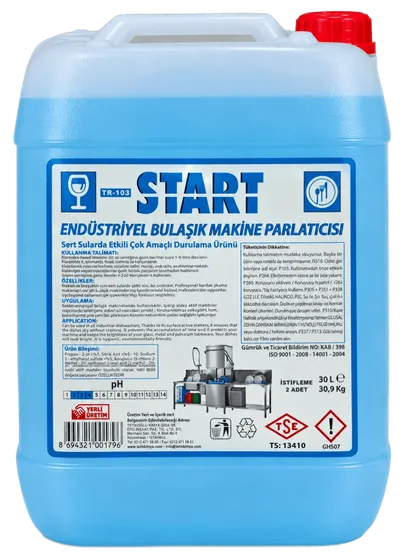
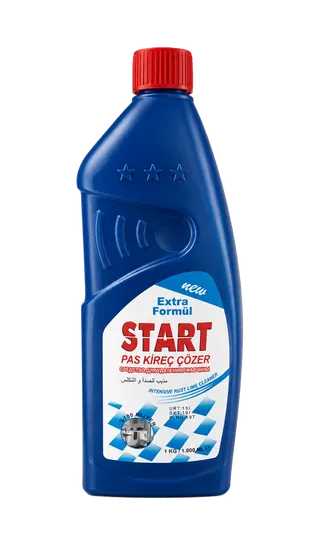
Our range has two products with limescale remover in their name: START Limescale & Rust Remover for surfaces and START Dishwasher Descaler / Limescale Inhibitor for dishwashers. They are used in different places; one does not replace the other.
What does a limescale remover do?
- Scale on surfaces: Used to dissolve scale on shower glass, ceramics, toilets and basins. For methods by surface, see how to remove limescale stains.
- Rust and scale crust: START Limescale & Rust Remover is also used for rust and hard crust along with limescale. A product summary is in what is limescale and rust remover.
- Scale inside machines: START Dishwasher Descaler / Limescale Inhibitor is used against scale building up in the tank, heating element and lines of the machine. The steps are in how to use dishwasher descaler.
Is a limescale remover an acid?
Yes, limescale removers are acidic. Limescale is a hard mineral layer left behind as water evaporates or heats up, and acidic products dissolve this kind of soiling better. According to its safety data sheet, START Limescale & Rust Remover has a pH of 1–2.
Acidity is what makes the product work, and it is also why the surface and safety rules matter. The meaning of the pH scale is explained in can cleaning products be mixed.
Types of limescale remover: which product for which job?
- Bathroom, kitchen and industrial surfaces: START Limescale & Rust Remover is for limescale, rust and hard crust.
- Dishwashers: START Dishwasher Descaler / Limescale Inhibitor is the product to look at for industrial dishwashers, hotel and restaurant kitchens and canteens.
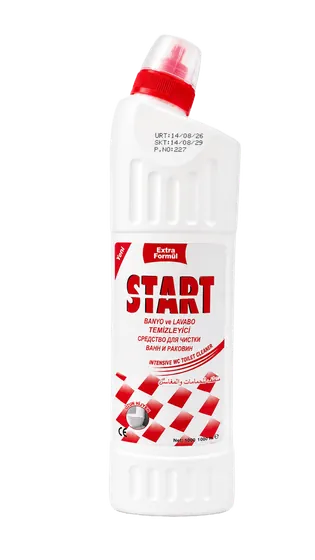
- Toilet, urinal and basin: START Bathroom & Toilet Cleaner is used to clean dirt and limescale together: what is a bathroom and toilet cleaner.
- Hydrochloric acid cleaner (tuz ruhu): A hydrochloric acid solution and a separate product. For the difference, see is limescale remover the same as hydrochloric acid.
- Limescale inhibitor: Helps prevent scale forming in machines; it is not meant to dissolve existing scale: what is a limescale inhibitor.
What does a limescale remover not do?
- Not for daily cleaning: It is not a daily wiping product.
- Not for every appliance: A limescale remover made for bathrooms does not go into a washing machine or dishwasher; acid can damage the machine's rubber and metal parts. For washing machines, see how to clean a washing machine.
- Does not stop new scale: Scale builds up again as hard water is used. Keeping shower glass and the area around fittings dry slows the build-up.
- Does not replace the label: Measure and contact time are on the product label. The steps are in how to use a limescale remover.
Which surfaces are unsuitable for limescale remover?
- Marble, travertine and natural stone: Acid burns and dulls these surfaces. For the method, see how to clean marble.
- Enamel: The glossy enamel of baths and basins can be permanently damaged.
- Chrome, fittings and other metals: Keep the product off taps, fittings, aluminium, copper and brass.
- Cement-based grout: Frequent or prolonged application wears the grout away.
- Wood, paint, textiles and carpet: Keep the product away from these.
Safety when using limescale remover
- START Limescale & Rust Remover: The safety data sheet carries the signal word "Danger" and the statements H314 (severe skin burns and eye damage), H318 (serious eye damage) and H335 (respiratory irritation).
- START Bathroom & Toilet Cleaner: According to the safety data sheet, the pH is 1–2 in a 1% solution. The sheet carries the signal word "Danger" and the statement H314.
- START Dishwasher Descaler / Limescale Inhibitor: An acidic cleaner. Read the warnings on the label of the product you buy.
- Protection: Wear gloves and safety goggles, and ventilate the room.
- Spraying: Do not transfer the product to a spray bottle or spray it onto surfaces.
- Contact: If it touches skin or eyes, rinse at once with plenty of water and get medical help.
- Storage: Keep in the original packaging, tightly closed and upright, out of children's reach. Keep away from food.
- Data sheet: A safety data sheet can be requested for START Limescale & Rust Remover and START Bathroom & Toilet Cleaner; the list and how to request are on the safety data sheets page.
What should a limescale remover never be mixed with?
Do not mix limescale remover with bleach, chlorinated products or alkaline products; mixing with chlorinated products releases toxic chlorine gas. Do not mix it with hydrochloric acid cleaner either. If you use another product on the same surface, rinse with plenty of water in between.
The label of START Dishwasher Descaler / Limescale Inhibitor also states that it must not be used with bleach. Details are in can cleaning products be mixed.
Our limescale removers: packaging and bulk purchase
- START Limescale & Rust Remover: 1 KG (16 per case), 5 KG (4 per case), 20 KG and 30 KG (sold singly).
- START Dishwasher Descaler / Limescale Inhibitor: 5 KG (4 per case), 30 KG (sold singly).
- TSE certificate (limescale and rust): START Limescale & Rust Remover is TSE certified to TS 13414 (limescale, rust and scale remover) (certificate no. 177188-TSE-02/02).
- Tetikoğlu Kimya is a limescale remover manufacturer; we present our plant in Istanbul İkitelli OSB on the production page. The general steps are in how limescale remover is made.
- Hotels, schools, factories and cleaning companies can see the wholesale limescale remover guide to choose a product and pack size, and use the quote form for prices.