Guide · Car wash and vehicle care
How to Use Tyre Shine
Tyre shine is used after washing to give tyres a dark, well-kept look. Applied correctly, it completes the car's overall appearance; applied incorrectly, it can create slippery surfaces and spatter marks.
Where to apply it and where not
- Apply to: The tyre sidewall.
- Do not apply to: The tread (the surface in contact with the road), brake discs and pads, or surfaces that must not be slippery such as pedals and the steering wheel.
- Wipe off any product that gets on the rims or paintwork immediately.
- For cleaning the wheels: how to clean car wheels.
- Tyre shine is not used on motorcycle tyres; in a bend the side of the tyre also touches the road (how to wash a motorcycle).
Step-by-step application
- Clean the tyre: The tyre should be washed with car shampoo and rinsed. Shine applied to a muddy tyre traps the dirt.
- Dry: Remove water from the tyre surface; the product spreads more evenly on a dry surface.
- Apply a thin layer: Preferably put the product on an applicator sponge and spread a thin, even layer over the sidewall; when spraying onto the tyre, keep it off the rim and brake disc.
- Remove the excess: After a few minutes, wipe off excess product with a clean cloth; this reduces spatter onto the paintwork while driving.
- Let it dry: Allow the product to dry before driving the car.
How to apply tyre shine: sponge, brush and applicator
- Curved applicator sponge: A sponge curved to sit on the tyre sidewall spreads the product most evenly; the product is taken onto the sponge and the sidewall is covered in one pass without overlapping.
- Foam pad: Flat foam pads are enough for small and medium tyres; work with the edge of the pad so that it does not spill over onto the rim.
- Brush: On sidewalls with raised lettering and patterns, the product is worked into the recesses with a brush; the brush is used only for tyres and never touches the paint.
- Spraying: A spray product is preferably sprayed onto the applicator; when spraying onto the tyre, the rim, brake disc and paint must not get wet.
- Removing the excess: After a few minutes the sidewall is wiped lightly with a clean microfibre cloth; the thin layer that remains is what lasts, the excess is what slings.
- Applicator care: The sponge and pad are washed with car shampoo water after use and dried; a hardened sponge leaves the product uneven and is replaced.
Water-based vs solvent-based tyre shine
- Water-based products: usually give a satin or natural shine, spread easily and any excess can be wiped off with water.
- Solvent-based products: usually give a higher gloss and last longer; if not applied in a thin layer they can sling onto the paint while driving.
- Whatever the type, the product label should state that it is suitable for tyre sidewalls, and it should be applied in a thin layer.
Matt, satin and high gloss: how to get each finish
- Matt, natural look: A thin layer of water-based product is applied and the excess wiped off at once with a cloth; the tyre looks new-black without shining.
- Satin look: One coat of water-based product left to dry on its own without wiping; the in-between finish most users prefer.
- High gloss: A solvent-based product or a second coat of water-based product; the second thin coat goes on after the first has dried, and the excess must be removed because of the sling risk.
- Cleaning off old layers: Built-up layers look brownish and blotchy; the sidewall is washed with car shampoo and a tyre brush that is not too stiff, rinsed and then the product is reapplied.
- Tyres turning brown: The brown layer left by protective compounds migrating from the tyre to the surface is not covered by tyre shine; it is first washed off with a brush, then the shine is applied.
- Caution: Whatever the finish, the product is applied only to the sidewall, thinly and evenly; it does not touch the tread, the brakes or the pedals.
How often is it applied?
Tyre shine is usually applied after every car wash, while the tyre is clean and dry. Rain, snow and salted roads make the shine fade faster. To avoid old layers building up, wash the tyre with car shampoo before each new application.
Common mistakes and sling marks
- Applying to a dirty or wet tyre: The product traps dirt and spreads unevenly; the tyre must be washed and dry.
- Too much product: A thick layer does not dry and slings onto the paint and inside the wheel on the first drive; apply thinly and wipe off the excess with a cloth.
- Spraying without control: Product sprayed without control from the bottle reaches the wheel and the brake disc; spray only onto the sidewall or apply with a sponge.
- Applying in the sun or to a hot tyre: The product dries quickly and looks patchy; work in the shade while the tyre is cool.
- If sling marks have formed: Wash the marks on the paint and inside the wheel with car shampoo and a microfibre cloth without delay; repeat several times for dried solvent-based marks, and do not use abrasives or solvents.
Tips for car wash businesses
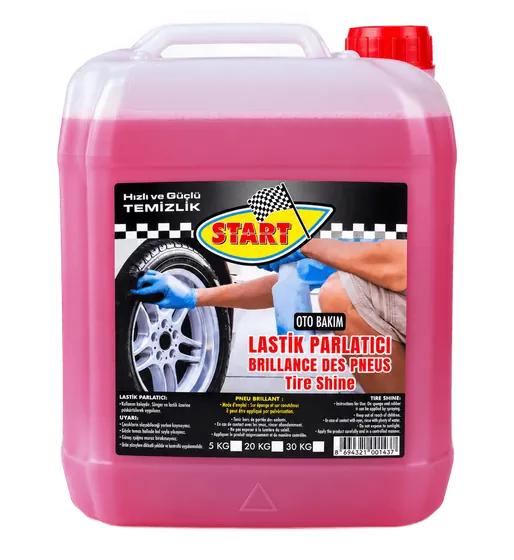
To use the same amount of product on every car, metered spray bottles or sponge application can be preferred. When filling bottles from a large pack, labelling the bottles prevents different products from being mixed up. START Tyre Shine comes in a 5 kg pack; product information is on the car care chemicals page.
Related guides
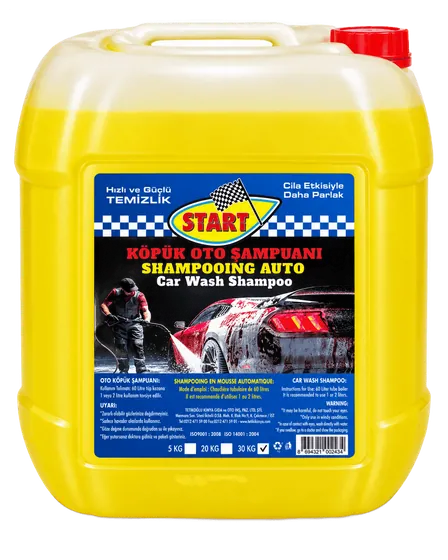
For washing steps, see how to use car shampoo; for all vehicle care products, see the car care products page.