Guide · Product information and safe use ·
What Is Cream Cleaner?
Cream cleaner is a thick cleaning product that scrubs off stubborn dirt using fine mineral particles. It is used where liquid cleaners are not enough, on stuck-on dirt on hobs, sinks, bathtubs and ceramics. In this article we explain what cream cleaner is, and where and how to use it.
Where is cream cleaner used?
- Burnt-on and stuck dirt on hobs and oven glass
- Stains on washbasins, sinks and bathtubs
- Stubborn dirt on ceramic and tile surfaces
- Kitchen worktops
- Step by step for hob tops and glass hobs: how to clean a hob.
- For sooty stove and fireplace glass: how to clean stove glass.
- For burnt marks on oven glass: how to clean oven glass.
What is in cream cleaner?
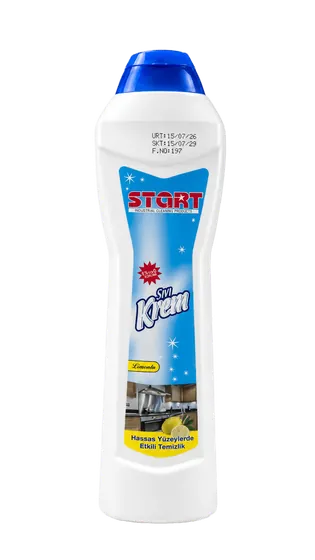
Cream cleaners consist of fine mineral particles that clean by scrubbing, surfactants that dissolve dirt and ingredients that give the product its creamy texture. The particles do not dissolve in water; when rubbed on a surface they mechanically scrape off stuck-on dirt. That is why cream cleaner is also called scouring liquid or mineral cream. According to its safety data sheet, START Mineral Scouring Liquid has a pH of 7–12.
How to use cream cleaner
- Wear gloves and safety goggles, and ventilate the area.
- Shake the container well before use.
- Apply the product to a damp sponge or cloth and rub the surface.
- Wipe with a damp cloth and rinse thoroughly with water.
- Test first on a small area of glass, acrylic and glossy surfaces that scratch easily.
Using cream cleaner by surface
- Hob: On enamel and stainless steel hobs with a damp sponge, leaving it for a few minutes on burnt areas; on a glass ceramic hob test on a small area first and work only on a cold surface, pressing lightly.
- Oven door glass: With the oven cold, take the cream onto a damp cloth and rub the burnt marks with a circular motion; product applied to the inner glass is rinsed with plenty of water, otherwise it leaves marks when heated.
- Stainless steel sink: On a brushed finish rub along the grain of the steel, circular movements leave dull marks; on polished (mirror) steel test first, then dry.
- Enamel bath and washbasin: Leaving the cream on for a while opens up a stubborn dirt ring; on worn, dull enamel keep the rubbing light. On an acrylic bath only after testing, and very gently.
- Tiles and grout: It can be used freely on ceramic tiles; work the grout with an old toothbrush and rinse the cream out of the grout with plenty of water, residue leaves white lines.
- Outside of pots and pans: Burnt grease on the outside of a stainless steel pot comes off with the cream; it is not applied to non-stick and ceramic-coated inner surfaces.
- The order of cleaning a sink is in the how to clean a sink guide.
Which surfaces should it not be used on?
- Mirrors and window glass: the mineral particles can leave scratches; use glass cleaner on these surfaces.
- Acrylic bathtubs and shower panels: test first on a small, hidden area.
- Polished marble and natural stone: the glossy surface can turn dull.
- Painted, lacquered and wooden surfaces: the scrubbing action can damage the finish.
- Non-stick pans and pots: the coating can be scratched.
Common mistakes
- Applying it dry to a dry surface: The particles cannot glide over the surface and the risk of scratching rises; dampen the sponge and the surface first.
- Pressing hard and using a scouring pad: The scrubbing power comes from the product; work with a soft sponge or cloth in light circular movements.
- Leaving it without rinsing: Dried product leaves a white film and dull marks; wipe it off with a damp cloth, rinse with plenty of water and dry metal surfaces.
- Using it together with another product: Do not use it at the same time as limescale remover, hydrochloric acid or bleach, or one after the other without rinsing in between.
- Trying it on every surface: On glossy, coated and soft surfaces, test first in a hidden corner; if it leaves marks, do not use it on that surface.
Safety information
According to its safety data sheet, START Mineral Scouring Liquid has a pH of 7–12 and the signal word "Danger": it causes serious eye damage (H318). Avoid contact with the eyes; if it gets into the eyes, rinse immediately with plenty of water for a long time and get medical help. The sheet says to avoid acids, acidic substances and alcohol; do not mix the product with other cleaning products: can cleaning products be mixed.
Cream cleaner vs liquid surface cleaner
Liquid surface cleaners are for the daily cleaning of large areas; cream cleaner gives scrubbing power for stubborn dirt on small areas. For daily floor and surface cleaning, see our article how to use surface cleaner.
Cream cleaner for restaurant kitchens and hotels
- Where: Hob tops and around the grill, stainless steel worktops and sinks, enamel baths and washbasins in hotel bathrooms, the outside of samovars and kettles in the tea room.
- When: For daily cleaning a surface cleaner is enough; the cream is used at the end of the shift and in weekly deep cleaning for burnt and stuck-on dirt.
- How: A soft sponge or white pad; wire wool and black pads scratch the surface. To avoid residue, rinsing with plenty of water and drying are written into the shift checklist.
- What it is not: It does not replace a degreaser; on stainless steel cooker hood filters and heavy grease, the degreaser comes first and the cream is used for the remaining burnt marks.
- Storage: The bottle is shaken before use, kept with the cap closed and away from food. For the hotel list see the hotel cleaning supplies list guide.
Mineral cream cleaner
START Mineral Cream Cleaner is in the surface cleaners category. Follow the label instructions for the amount to use.
Tetikoğlu Kimya is a surface cleaner manufacturer; we introduce our plant on the production page.