Guide · Carpets, sofas and upholstery ·
How Is Carpet Shampoo Made?
Carpet shampoo is made by mixing surfactants that loosen dirt from the fibres in water with a viscosity regulator, fragrance and preservative, then checking the batch and filling it into packaging. This article applies the steps in our how detergent is made guide to carpet shampoo; it gives no recipe or ratios.
How is carpet shampoo produced, in brief?
Carpet shampoo is produced by weighing the raw materials, mixing them into water in sequence, adjusting the viscosity, adding fragrance, checking the batch and filling it into packaging. The steps resemble general detergent production; the difference is that the product has to work on carpet fibre. Foam, viscosity and how well the foam comes off with clean water are therefore usually tracked separately.
What is carpet shampoo made of?
- Water: the product's carrier.
- Surfactants: the ingredients that loosen dirt from the fibres and form the foam during washing.
- Viscosity regulators: set how the product flows and pours from the packaging.
- Fragrance and colour: set the scent during washing and the look of the product.
- Preservative: helps the product stay stable throughout its shelf life.
- Ratios vary with each manufacturer's recipe and are not given in this guide. For the amount to use, follow the label on the packaging.
Production steps
- Weighing: the raw materials in the recipe are weighed for the batch size.
- Mixing: water goes into the tank, the surfactants are added in sequence and the mixture is stirred until uniform. The stirring speed is kept under control; otherwise too much foam forms in the tank.
- Viscosity adjustment: the regulator brings the product's flow to the target level.
- Fragrance and colour: added once the mixture is uniform.
- Checks: in carpet shampoo production, a batch sample is usually checked for appearance, viscosity, scent and foam.
- Filling: the approved product is filled on the filling machine into 1 KG packs, 5 KG PET containers and 20 KG and 30 KG drums.
- Capping, labelling, boxing: the cap goes on and the label is applied; 1 KG packs go into cartons of 16 and 5 KG PET containers into cartons of 4.
Quality control points specific to carpet shampoo
- Foam: producers usually check that the foam formed with a brush or sponge stays consistent from batch to batch.
- Foam removal: it is usually checked that the foam can be removed with a cloth dampened with clean water; shampoo left in the carpet attracts dirt.
- Viscosity: producers usually watch that the product pours from the packaging in a controlled way and disperses when diluted with water.
- Scent and appearance: scent and colour are usually compared with an approved sample.
- Label: it is usually checked that the product name, directions and warnings appear on the correct packaging.
- For the criteria to look at when choosing a manufacturer: what to check when choosing a cleaning products manufacturer.
How do hand and machine use affect production?
Where the product will be used affects the foam and viscosity criteria followed in production. In hand washing, the foam is spread on the carpet with a brush or sponge; in a carpet washing machine, the product goes into the clean water tank; in carpet washing plants, the amount is set according to the washing line and the properties of the water. So the method of use and the amount are read from each product's own label.
For the steps of use, see how to use carpet shampoo; for plant use, see carpet shampoo for carpet washing plants.
Common problems in production
- Too much foam in the tank: the stirring speed may have stayed too high; foam makes checks and filling harder.
- Viscosity deviation: the adjustment or the raw material batch may have changed; it is usually checked before filling.
- Cloudiness and sediment: the mixture is not uniform; the product usually does not move on to filling in this state.
- Scent deviation: it shows up when compared with an approved sample; the batch is usually not approved until the cause is found.
- Overflow during filling: a foaming product can spill over the mouth of the packaging, so filling speed and a clean mouth are usually monitored.
Can carpet shampoo be made at home?
We do not recommend home-made mixtures and give no recipe in this guide. A mixture of uncertain proportions can stay in the carpet as residue, attract dirt and raise the risk of colour bleeding. Mixing cleaning products with each other is also dangerous: can cleaning products be mixed. Use a ready-made, labelled product on carpets and first do a colour test in a hidden corner.
Storage and transport after production
- Packaging with the cap tightly closed is kept in a cool place out of the sun.
- The product is stored away from food and out of children's reach.
- When decanting from a large drum, a clean funnel and a container marked with the product name are used.
- For details: how to store and transport cleaning products.
For businesses
- Carpet washing plants: 20 KG and 30 KG drums are the options to consider; the amount is set from the label according to the washing line and the properties of the water.
- Hotel, office and mosque managers: first determine the carpet type and washing method; wool, silk and hand-woven carpets go to a professional carpet washer.
- Cleaning companies: on sofa and upholstery jobs, the product is first tried on a small area: can a sofa be wiped with carpet shampoo.
- Dealers and wholesale buyers: packaging, carton quantity and product code can be compared on the category page; details are on the wholesale cleaning products and dealership and distribution pages.
Sourcing from the manufacturer
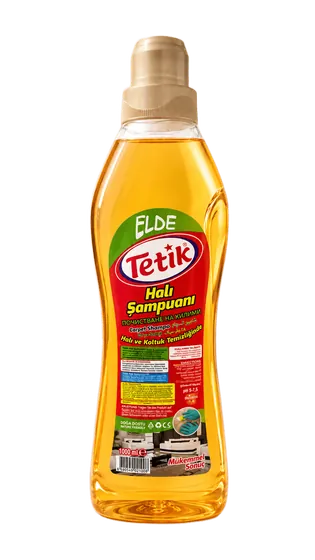
As a carpet shampoo manufacturer, Tetikoğlu Kimya offers TETİK Carpet Shampoo in 1 KG (cartons of 16), 5 KG PET (cartons of 4), 20 KG and 30 KG packaging. TETİK Binbir Stain Remover (Carpet Shampoo) comes under its own name and label in 30 KG packaging.
Our carpet shampoo production facilities are in İstanbul İkitelli OSB; details are on the production page. For bulk purchases you can request a quote.