Guide · Product information and safe use
Is Hydrochloric Acid an Acid or a Base? pH Value, Which Acid It Is and How It Differs from Nitric Acid
Hydrochloric acid is an acid. It is a solution of hydrogen chloride in water, ranks among the strong acids and has a pH far below 7; it is neither a base nor neutral. In this guide we explain, as a manufacturer, which acid this household product actually is, where it sits on the pH scale, how it differs from nitric acid and what its being an acid changes in cleaning.
Is hydrochloric acid cleaner an acid or a base?
Hydrochloric acid is an acid. Tuz ruhu is the common Turkish name for the hydrochloric acid solution formed when hydrogen chloride dissolves in water. Because it ionises almost completely in water, it counts as a strong acid; its pH is far below 7 and it turns blue litmus paper red.
It is not basic, and it is not neutral either. This distinction is more than a piece of chemistry knowledge: the fact that it is an acid determines which soils it dissolves, which surfaces it damages and which products it cannot be used alongside.
- Type: strong acid (hydrochloric acid solution).
- pH: far below 7; at the acidic end of the scale.
- Litmus: turns blue litmus paper red.
- Soils it dissolves: mineral soils such as limescale, urine scale, rust and cement residue.
- Surfaces it damages: marble and natural stone, enamel, metal and cement-based grout.
Which acid is tuz ruhu (spirit of salt), and what is its formula?
Tuz ruhu is hydrochloric acid; its chemical formula is HCl. Older Turkish sources also call it klorhidrik asit (chlorhydric acid). The product sold for cleaning is a solution of this acid diluted with water.
The name comes from the history of its production: because hydrochloric acid was long obtained from table salt, it came to be called tuz ruhu, literally "spirit of salt". The same naming exists in other languages too; details are in the language section of the how to use hydrochloric acid guide.
We do not disclose the concentration, composition or production measurements of our products; the general steps of the production process are in the how hydrochloric acid is made guide.
What is the pH of hydrochloric acid?
The pH of hydrochloric acid is far lower than 7; the product sits at the acidic end of the pH scale. The exact figure depends on the product's concentration and is stated in its safety data sheet, which is why we do not give a single number here.
The pH scale runs from 0 to 14: 7 is neutral, below 7 is acidic and above 7 is basic. The scale is logarithmic; a solution whose pH is one unit lower is ten times more acidic. Strong acids sit at the very bottom of the scale, strong bases at the very top.
Where do our products sit on the pH scale according to their safety data sheets?
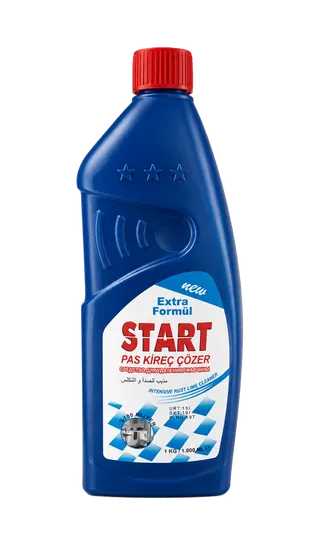
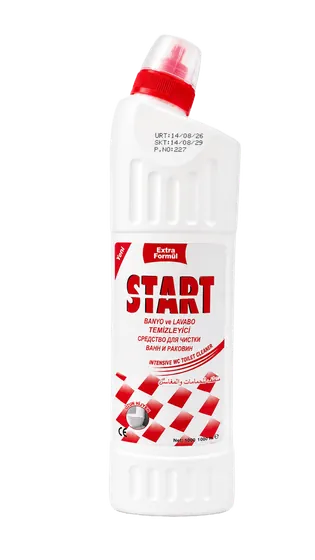
The values below are taken from each product's safety data sheet (SDS); they show which products are on the same side as hydrochloric acid and which are on the opposite side. START limescale and rust remover, at pH 1–2, and START bathroom and toilet cleaner, at pH 1–2 in a 1% solution, are on the acidic side. START all-purpose surface cleaner, at pH 7–8, is close to neutral. START degreaser, at pH 12, and START bleach, at pH 12–14, are on the basic side.
A product-by-product comparison is in the is surface cleaner an acid or a base guide.
Does diluted hydrochloric acid become neutral?
No. As water is added the acid becomes more dilute and the pH rises, but the solution remains acidic; diluting with water does not make the product neutral or harmless. If dilution is needed, take the measure from the packaging label, and always add the acid to the water.
Is hydrochloric acid the same as nitric acid (kezzap)? The difference between the two
No, hydrochloric acid is not nitric acid. Tuz ruhu is hydrochloric acid, whereas kezzap (aqua fortis) is nitric acid. Both are strong acids but they are different substances; using the two names interchangeably in everyday speech is a mistake.
Nitric acid is also a powerful oxidiser and is not a product used in household cleaning. There is no nitric acid in our product range; the acidic products we make for limescale and mineral soils are hydrochloric acid, limescale and rust remover, and bathroom and toilet cleaner.
- Tuz ruhu (spirit of salt): hydrochloric acid (HCl). Used in cleaning for hardened limescale, urine scale and cement residue.
- Kezzap (aqua fortis): nitric acid (HNO₃). An industrial chemical; not a household cleaning product.
- Oil of vitriol: sulfuric acid (H₂SO₄). An industrial chemical; not a household cleaning product.
- Sirke ruhu (spirit of vinegar): acetic acid. A weak acid; not the same substance as hydrochloric acid.
- All four are acids; that is why school textbooks mention hydrochloric acid and nitric acid together as examples of acids.
What does being an acid mean in cleaning?
Acids dissolve mineral soils. Limescale, urine scale, rust and cement residue react with acid and dissolve; that is why hydrochloric acid works on hardened limescale in the toilet bowl. Grease and burnt-on dirt, on the other hand, are a job for alkaline products; hydrochloric acid does not dissolve grease.
The same reaction turns into damage on the wrong surface. Marble and travertine are limestone too; acid dissolves them along with the dirt and leaves a permanent dull stain. It corrodes metal and eats out cement-based grout. We explain step by step how to apply it on each surface, and where not to use it, in the where and how to use hydrochloric acid guide.
- Dissolves: limescale, urine scale, rust stains on ceramic and porcelain, cement and mortar residue.
- Does not dissolve: grease, burnt-on food residue and other organic soils.
- Damages: marble, travertine, natural stone, enamel, chrome, aluminium, stainless steel, cement-based grout.
- Resistant surfaces: glazed ceramic and porcelain.
What happens if hydrochloric acid is mixed with alkaline products or bleach?
When an acid meets a base, they neutralise each other: both lose their effect and heat is released during the reaction. Mixing hydrochloric acid with an alkaline product such as a degreaser does not give a stronger cleaner but an ineffective mixture that carries a risk of splashing.
Bleach is a separate danger. Bleach is alkaline and contains sodium hypochlorite; when it meets an acid such as hydrochloric acid, toxic chlorine gas is released. These two products must not be mixed; if they are to be used one after the other on the same surface, rinse with plenty of water in between. Details are in the can cleaning products be mixed guide.
Hydrochloric acid, limescale remover and toilet cleaner: are they all acids?
Yes, all three are acidic products; the difference lies in their composition and where they are used. Hydrochloric acid (tuz ruhu) is a hydrochloric acid solution used occasionally for thick, hardened limescale. Limescale and rust remover and bathroom and toilet cleaner are acidic cleaners formulated for regular use.
Because all three are acids, the same rules apply: do not mix them with bleach, do not use them on marble or metal, and apply them wearing gloves and goggles. We compare which one to choose and when in the is limescale remover the same as hydrochloric acid guide.
Precautions to take because it is an acid
- Protection: wear gloves and safety goggles; the product must not come into contact with skin or eyes.
- Ventilation: acid vapour is irritating; in a closed bathroom, open the window or run the extractor fan.
- Dilution order: add the acid to the water; do not pour water onto the acid.
- Choice of container: use a plastic or glass container; acid corrodes a metal bucket.
- Use on its own: do not mix with bleach, chlorinated toilet blocks or other cleaners.
- Storage: keep in its original, labelled packaging, on a separate shelf from bleach and out of the reach of children.
- In case of contact: rinse with plenty of water for a long time and seek medical help; if swallowed, do not induce vomiting and call a poison centre (in Turkey: UZEM, 114).
- We cover its vapour, skin contact and risks separately in the is hydrochloric acid harmful guide.
TETİK and START hydrochloric acid
We produce hydrochloric acid in different sizes, from household bottles to commercial jerrycans. Product codes and case-quantity details are on our bathroom and toilet products page.
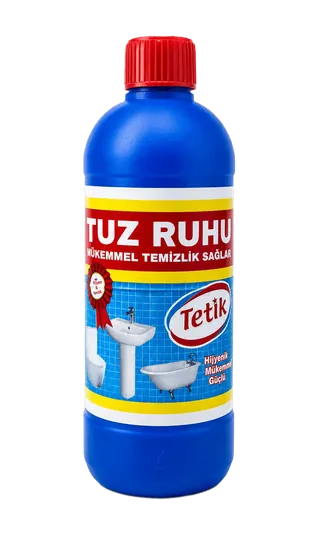
- TETİK Hydrochloric Acid Cleaner (Tuz Ruhu): 600 GR (20 per case) and 2.5 KG (6 per case).
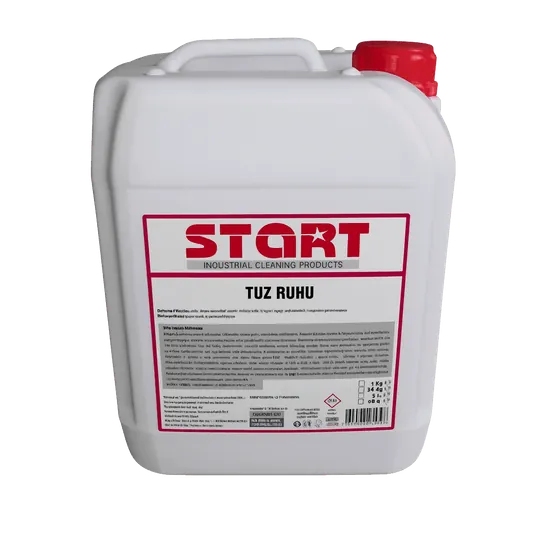
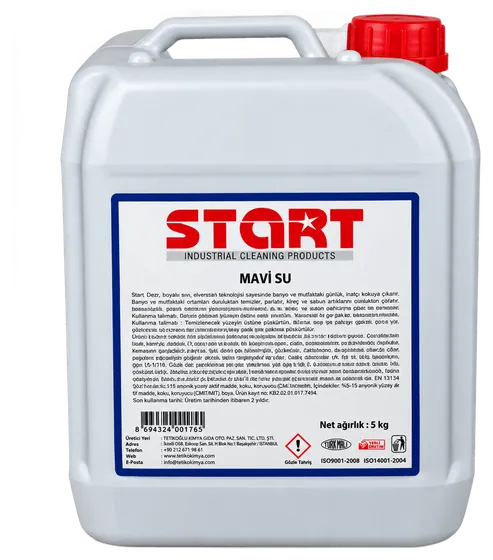
- START Hydrochloric Acid Cleaner: 5 KG (4 per case) and 30 KG (sold singly).
- Businesses, dealers and institutions can request a quote; prices and terms are given in the quote.