Guide · Product information and safe use ·
How to Use Dishwasher Rinse Aid
There are two ways to use dishwasher rinse aid: filling the machine's compartment or connecting it to the dosing pump. This guide explains the steps for both, what the setting depends on and what to check after the wash.
How is dishwasher rinse aid used?
Dishwasher rinse aid is used by filling the machine's rinse aid compartment or connecting it to the dosing pump. The machine takes up the product by itself at the rinse stage. Dosing is set by water hardness and the machine manufacturer's recommendation; for the measure, see the label.
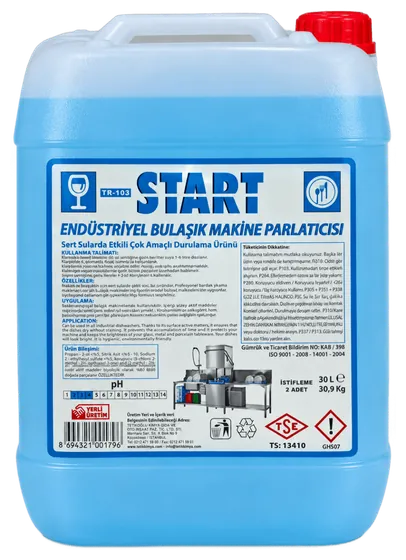
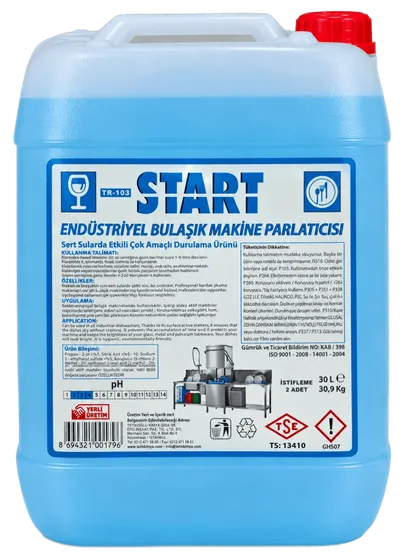
Our catalogue includes START Liquid Dishwasher Rinse Aid and START Liquid Dishwasher Rinse Aid — Formül. For what it does and how it differs from detergent, see the what is dishwasher rinse aid guide.
What should you check before starting?
- Compartment or pump: Check in the manual whether your machine takes rinse aid from a compartment or a dosing pump.
- Machine type: The use stated on the START Liquid Dishwasher Rinse Aid label is industrial dishwashers. On a household machine, follow your machine's manual.
- Water hardness: The setting depends on it; find out your water hardness.
- Label: Read the product label for use and warnings.
How do you fill rinse aid in a machine with a compartment?
- Find the compartment: Locate the rinse aid compartment in the machine's manual; do not confuse it with the detergent compartment.
- Fill: Fill the compartment with the product and wipe up any spills.
- Close: Close the compartment lid.
- Set it: Adjust the dosing according to water hardness and the machine manufacturer's recommendation.
- Keep track: Refill before the compartment runs empty; the machine takes the product itself, so it is not added by hand at each wash.
How is rinse aid connected on a machine with a dosing pump?
- Correct line: Fit the suction hose to the rinse aid pump line; do not confuse it with the detergent hose.
- Separate pump: The detergent and rinse aid pumps are not connected to each other.
- Setting: Have the machine service set the pump.
- Changing the pack: Switch to a new pack before the product runs out; do not combine old and new product in one pack.
- When the product changes: Have the machine service set it again.
What does the rinse aid setting depend on?
The setting has two criteria: water hardness and the machine manufacturer's recommendation. This guide gives no figures; the measure is always the one on the label.
- Find out the water hardness: Use a test strip or have your service measure it.
- When the water changes: Set it again when the water hardness changes.
- Check the result: Inspect the glasses after the first washes. Signs of too little and too much rinse aid are in the what is dishwasher rinse aid guide.
What should you do if you see a problem after the wash?
- Drop marks on glasses: See whether the compartment or pack is empty, then check the setting.
- Blue-purple film on glasses: Lower the setting; on pump machines, have the service do it.
- Limescale built up in the machine: Rinse aid does not dissolve it: how to remove limescale from a dishwasher.
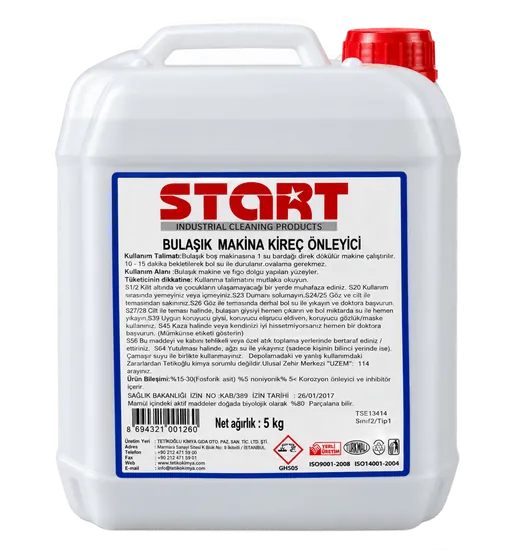
- Build-up caused by hard water: For prevention, see how to use a limescale inhibitor.
- Dishes coming out dirty: Rinse aid may not be the cause: why a dishwasher does not clean properly.
- Cloudy glasses: If it comes from residue, it goes away with correct washing and rinsing; if the glass surface is worn, it is permanent: how to polish glasses.
Common mistakes when using rinse aid
- Putting it in the detergent compartment: Rinse aid goes in its own compartment.
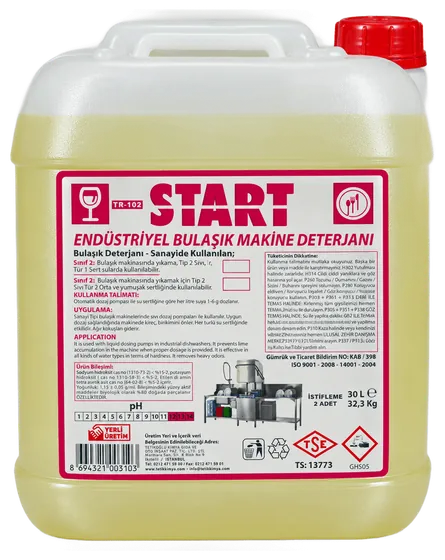
- Using it instead of detergent: Rinse aid does not clean dirty dishes. For the washing side, see using industrial dishwasher detergent.
- Leaving the compartment empty: If it is empty, glasses come out spotted.
- Changing the setting by guesswork: Go by the measure on the label, the water hardness and the machine manufacturer's recommendation.
- Mixing with another product: Do not mix rinse aid with other cleaning products: can cleaning products be mixed.
Daily checks in hotels, restaurants and canteens
Rinse aid is used in industrial dishwashers, hotel and restaurant kitchens, canteens, glass washing in cafés and bars, and hospital and school kitchens.
- Before service: Check the product level in the compartment or pack.
- Several machines: Record each machine's setting and product changes separately.
- Instructions: Write in the staff instructions where rinse aid goes and who sets the pump.
- Machine care: For filters and arms, see how to clean a dishwasher.
Packaging, certification and bulk purchasing
- START Liquid Dishwasher Rinse Aid: 30 KG (sold individually).
- START Liquid Dishwasher Rinse Aid — Formül: 20 KG (sold individually).
- Certificate: START Liquid Dishwasher Rinse Aid and START Liquid Dishwasher Rinse Aid — Formül are TSE-certified to TS 13410 (Rinse aid – used in dishwashers); certificate details are on the certificates page.
- Tetikoğlu Kimya is a manufacturer of dishwasher rinse aid; we present our plant on the production page.
- For wholesale purchasing, see the wholesale dishwasher rinse aid guide; for prices use the quote form.